The rabbit-hole obsession with a case
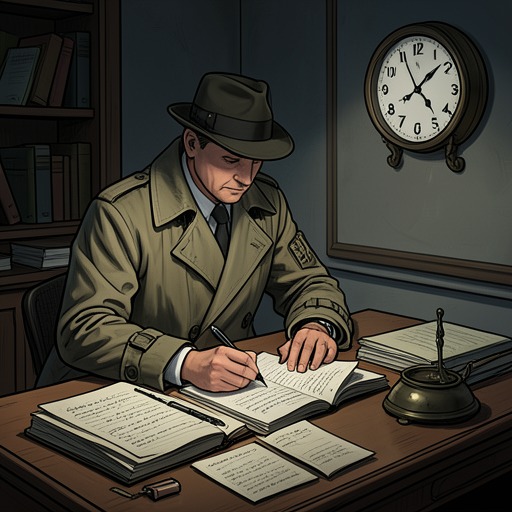
I'll Be Gone in the DarkThe rabbit-hole obsession with a case is the book’s name for an investigation that ceases to be a bounded task and begins to organize the investigator’s attention, habits, and relationships. In the pursuit of the East Area Rapist / Original Night Stalker, searching is at once a route toward an answer and a compulsion that resembles, in unsettling ways, the behavior under investigation. The idea applies both to Michelle McNamara’s immersion in the case and to the amateur researchers she encounters: their work can be careful and potentially useful even as the investment makes it harder to stop.
From calling to immersion
The Social Worker describes feeling spiritually called to help solve the case, but pairs that sense of purpose with a warning: investigators must care for themselves because the work can consume them. The warning lands against a history of immersion. Michelle McNamara and The Social Worker have spent hours discussing the case; at dinner parties, McNamara’s husband recognizes when the conversation is about to turn to it and signals her to stop. The investigation has crossed from research into social life, where its recurring presence is noticed by someone close to her.
The account also makes the obsession concrete through the minutiae it encourages. McNamara once pursued details about a member of the 1972 Rio Americano High School water polo team because a yearbook photograph seemed to match a suspected physical trait. On another occasion, after dining with a suspect, she collected his water bottle for DNA testing. In the case files, names arranged surname-first could become a trap for an exhausted reader: at one especially dazed point, she began investigating what appeared to be a person named Lary Burg before recognizing that the entry was simply the word burglary. Each episode shows attention narrowing until a photograph, an object, or even the order of words can acquire investigative significance.
The most startling consequence described is an episode at home. One night, McNamara’s husband entered the bedroom quietly, trying not to wake her. She leapt from bed and swung a lamp at him, missing. In the morning, she found the lamp overturned and remembered what she had done; after registering the incident, she returned to the police reports and continued studying them. The sequence places alarm, recognition, and renewed research side by side. The work is not merely occupying spare hours: in this account, it persists even after a moment that makes its cost unmistakable.
The search becomes self-reinforcing
The rabbit-hole image carries an irony. McNamara agrees to pretend that she and The Social Worker are only approaching the hole, although the preceding account shows how deeply the case already occupies their time and thinking. The language of approach offers a small verbal distance from an involvement that the details contradict. The book does not present that contradiction as proof that research is worthless; rather, it shows how readily a person can acknowledge the danger while continuing the behavior.
McNamara also reflects on the reward built into seeking itself. She recalls experiments in which captive animals work to find food rather than simply receive it, and considers the possibility that the pursuit, not only the answer, sustains the search. That observation changes the meaning of the researchers’ energy: progress toward identification matters, but so does the repeated act of looking. She recognizes an uncomfortable resemblance between the investigators’ relentless searching and the compulsive conduct attributed to the person they are trying to identify. The analogy is a source of unease, not an equivalence between the researchers and the perpetrator. It reveals how the case can shape the habits and imagination of those who pursue it.
A collective investigation
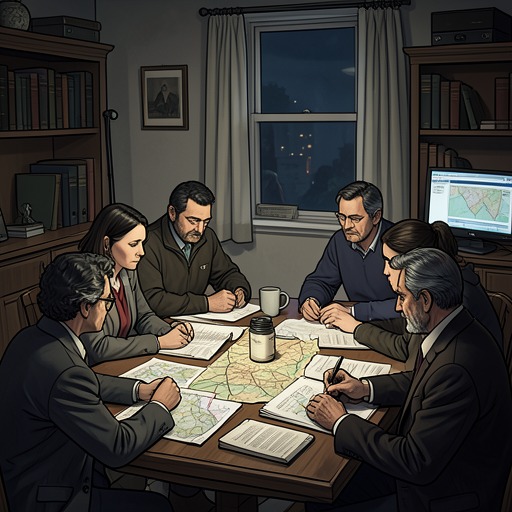
The obsession is not confined to McNamara. The Kid, a thirty-year-old man with a film degree and a troubled family relationship, has made the case a major undertaking despite having no personal connection to it. He is described as intelligent, meticulous, and sometimes brusque; McNamara considers him the strongest hope among the amateur researchers. His precision appears in small choices as well as in his casework: he stopped watching a cable broadcast of Dirty Harry when the picture’s aspect ratio changed after the opening credits. That example makes his attention to detail legible beyond the investigation, while the scale of his case research gives it consequential purpose.
The case’s geographic pattern offers one reason such work can seem promising. A strong lead is the route across Sacramento, Santa Barbara County, and Orange County, combined with the limited period in which the offender lived or worked in those areas. The book frames the search as a narrowing problem: only a finite group of white men born between roughly 1943 and 1959 fit those broad geographic and chronological conditions. The Kid’s contribution is not a claim that this filter has solved the case, but a sustained effort to organize people and records against it.
He eventually gives McNamara The Master List, a 118-page document containing information on about two thousand men. It includes birth dates, address histories, criminal records, and photographs when available, and has an index. Some entries contain terse personal or family notations whose significance depends on an extensive knowledge of the case. The document’s scale makes visible both the discipline and the risk of the undertaking: a vast accumulation of details can make a search more navigable, while also binding its compiler more tightly to the work.
Investment, limits, and public judgment
The Kid recognizes that the project may have to end. In an email to McNamara, he describes the irony that the more time and money he puts into an impractical endeavor, the more inclined he becomes to continue, partly so that identifying the killer might justify what he has invested. The reasoning gives the rabbit-hole obsession an economic as well as emotional shape: past effort becomes a reason for further effort, even when the work has no clear personal payoff. His hope of solving the case and his awareness of the cost coexist, without a settled resolution between them.
Online, not everyone regards the amateur researchers as serious contributors. One critic characterizes them as untrained meddlers with an unhealthy fascination with violent crime. The criticism marks a divide between the researchers’ sense that detailed work may help and outsiders’ suspicion that such involvement is intrusive or self-important. The book gives the criticism without making it the final measure of their efforts. Instead, it leaves usefulness and cost in tension: geographical analysis and indexed records represent methodical labor, while hours absorbed, strained social boundaries, and mounting personal investment show how the search can take on a life of its own.
The concept therefore describes more than enthusiasm for an unsolved case. It identifies a feedback loop in which clues invite more searching, searching accumulates records and relationships, and accumulated effort makes withdrawal increasingly difficult. The investigators seek an answer about someone whose identity remains unknown, but their own attachment to that answer becomes part of the story. The rabbit hole is both a figure for investigative depth and a warning about what the pursuit can consume.